


“Artists are often the seismographs of the current times, who sense the changes in society at the forefront.”
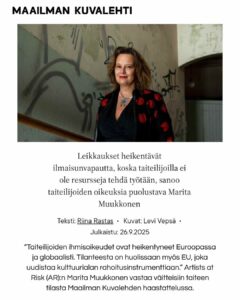
AR co-director Marita Muukkonen was interviewed by Riina Rastas for Maailman Kuvalehti about the worsened human rights situation of artists worldwide.
Marita brought up that this is, for example, the result of the situation in Ukraine, Palestine, Sudan, Afghanistan, and the Democratic Republic of Congo escalating in the last few years. The position of women and queer artists is especially dire in a lot of places globally.
The poor human rights situation of artists is showing in Artists at Risk (AR)’s work as growing numbers of applicants seeking for help and protection, Marita described. She also expressed that even in Finland, the situation has gotten worse due to the significant government cuts to the cultural sector––also threatening the UN Universal Declaration of Human Rights article on the right to enjoy and participate in arts and culture.
Thank you to Maailman Kuvalehti and Riina Rastas!
Source: Maailman Kuvalehti by Riina Rastas, 26.9.2025 https://maailmankuvalehti.fi/2025/3/henkilot/leikkaukset-heikentavat-ilmaisunvapautta-koska-taiteilijoilla-ei-ole-resursseja-tehda-tyotaan-sanoo-vainottuja-taiteilijoita-puolustava-marita-muukkonen/
Automated Machine Translation:
Cuts weaken freedom of expression because artists lack the resources to do their work, says Marita Muukkonen, who advocates for artists’ rights
Artists’ human rights have deteriorated globally, and the situation in Finland is not perfect either. Marita Muukkonen, from Perpetuum Mobile, an organization that supports persecuted artists, responds to claims about the state of the arts.
Text: Riina Rastas
Photos: Levi Vepsä
Published: September 26, 2025
Artists’ human rights have deteriorated globally.
It is clear that rights have worsened. In recent years, this has been influenced, for example, by Russia’s invasion of Ukraine, as well as the escalation of situations in Gaza, Sudan, Afghanistan, and the Democratic Republic of the Congo.
In many countries, artists are imprisoned or have been tortured. This is the case, for example, in Russia, Belarus, Cuba, Egypt, and Nigeria. Women artists and artists belonging to the LGBTQ+ community are in a particularly difficult situation. Self-censorship is another major issue.
More and more artists need protection.
Unfortunately, that is true. We received the first major wave of applications when the Taliban came to power in Afghanistan. We are talking about thousands of applications. Many applications have also come from Ukraine, Russia, Sudan, and Palestine. The number of applicants from Iran has increased. Our interpretation is that now that media attention is elsewhere, artists are being executed there.
At the moment, applications also reflect the situation in the Congo. We are aware of artist killings even as recently as August. We have relocated eight Congolese artists to a nearby region. We have 300 partner organizations around the world. Our goal is to enable artists to continue practicing their profession.
In Finland, artists’ rights are fully respected.
Even in Finland, artists’ rights have deteriorated in recent years. The government has cut funding for the cultural sector, most recently this year. Similar cuts have been made elsewhere in Europe.
These cuts weaken freedom of expression because artists lack the resources to do their work. This is also about people’s ability to experience art. The right to enjoy art and participate in cultural life is enshrined in the UN Universal Declaration of Human Rights. The EU is also concerned about the situation and is reforming its cultural funding instruments.
The way artists are treated reflects the state of society.
That is absolutely clear. Artists are often like seismographs of their time, sensing societal changes on the front lines. The strength of art lies in its ability to question society in many different ways. Art supports critical thinking and democracy and motivates people to act. It is also often part of protest movements. It helps sustain hope in difficult situations.
In authoritarian societies, dissenting artists are often targets of persecution. Dictators also try to recruit artists as their mouthpieces. This happened, for example, with the young Russian rapper Face. Vladimir Putin labeled him a “foreign agent” when he refused to cooperate. We relocated Face to Finland, from where he later moved to a country safer for Russian dissidents.
Who?
Marita Muukkonen
Profession: Founder and director of the Artists at Risk and Ecologists at Risk programs, operating under Perpetuum Mobile, together with Ivor Stodolsky.
Background: Master of Social Sciences. Has worked as a cultural secretary at the Ministry of Education and Culture, project director at the Nordic Institute for Contemporary Art, project coordinator at the Arts Council of Finland, and curator at Frame.
Hobbies: Art and cultural events, yoga, reading, and long walks.
PRESS TEXT:
Leikkaukset heikentävät ilmaisunvapautta, koska taiteilijoilla ei ole resursseja tehdä työtään, sanoo taiteilijoiden oikeuksia puolustava Marita Muukkonen
Taiteilijoiden ihmisoikeudet ovat heikentyneet globaalisti, eikä tilanne Suomessakaan ole täydellinen. Marita Muukkonen vainottuja taiteilijoita puolustavasta Perpetuum Mobile ry:stä vastaa väitteisiin taiteen tilasta.
- Teksti:
- Kuvat: Levi Vepsä
- Julkaistu: 26.9.2025
Taiteilijoiden ihmisoikeudet ovat heikentyneet globaalisti.
On selvää, että oikeudet ovat heikentyneet. Viime vuosina tähän on vaikuttanut esimerkiksi Venäjän hyökkäys Ukrainaan sekä Gazan, Sudanin, Afganistanin ja Kongon demokraattisen tasavallan tilanteen kärjistyminen.
Monissa maissa taiteilijoita on vankilassa tai heitä on kidutettu. Näin on esimerkiksi Venäjällä, Valko-Venäjällä, Kuubassa, Egyptissä ja Nigeriassa. Erityisen huonossa tilanteessa ovat naistaiteilijat sekä hlbtiq-yhteisöön kuuluvat taiteilijat. Oma lukunsa on itsesensuuri.
Yhä useampi taiteilija tarvitsee suojelua.
Pitää valitettavasti paikkansa. Meille tuli ensimmäinen suuri hakemusten aalto, kun Taliban nousi valtaan Afganistanissa. Puhutaan tuhansista hakemuksista. Paljon hakemuksia on tullut myös Ukrainasta, Venäjältä, Sudanista ja Palestiinasta. Hakijamäärät Iranista ovat kasvaneet. Meidän tulkintamme on, että nyt kun mediahuomio on muualla, siellä teloitetaan taiteilijoita.
Tällä hetkellä hakemuksissa näkyy myös Kongon tilanne. Tiedossamme on taiteilijoiden murhia elokuultakin. Olemme siirtäneet lähialueelle kahdeksan kongolaista taiteilijaa. Meillä on kolmesataa yhteistyöorganisaatiota ympäri maailman. Tarkoituksenamme on mahdollistaa taiteilijoille ammatinharjoittaminen.
Suomessa taiteilijoiden oikeudet toteutuvat moitteetta.
Suomessakin taiteilijoiden oikeudet ovat huonontuneet viime vuosina. Hallitus on leikannut kulttuurialan rahoituksesta viimeksi tänä vuonna. Samankaltaisia leikkauksia on tehty muuallakin Euroopassa.
Leikkaukset heikentävät ilmaisunvapautta, koska taiteilijoilla ei ole resursseja tehdä työtään. Kyse on myös ihmisten mahdollisuudesta kokea taidetta. Oikeus nauttia taiteesta ja osallistua kulttuurielämään on kirjattu YK:n ihmisoikeusjulistukseen. Tilanteesta on huolissaan myös EU, joka uudistaa kulttuurialan rahoitusinstrumenttiaan.
Se, miten taitelijoita kohdellaan, kertoo yhteiskunnan tilasta.
Se on ihan selvää. Taiteilijat ovat usein ajan seismografeja, jotka aistivat yhteiskunnan muutokset eturintamassa. Taiteen vahvuus on se, että se pystyy kyseenalaistamaan yhteiskuntaa monella eri tavalla. Taide tukee kriittistä ajattelua, demokratiaa ja saa ihmisiä liikkeelle. Taide on myös usein osa protestiliikkeitä. Sillä pidetään yllä toivoa vaikeissa tilanteissa.
Usein autoritaarisissa yhteiskunnissa vainon kohteeksi joutuvat toisinajattelevat taiteilijat. Diktaattorit pyrkivätkin rekrytoimaan taiteilijoita äänitorvikseen. Näin kävi esimerkiksi nuoren venäläisen räppärin Facen kohdalla. Vladimir Putin antoi Facelle kansainvälisen agentin tittelin, kun tämä kieltäytyi yhteistyöstä. Sijoitimme Facen Suomeen, josta hän on sittemmin siirtynyt venäläisille toisinajattelijoille turvallisempaan maahan.
Kuka?
Marita Muukkonen
Ammatti: Perpetuum Mobile ry:n yhteydessä toimivien Artists at Risk- ja Ecologists at Risk -ohjelmien perustaja ja johtaja yhdessä Ivor Stodolskyn kanssa.
Tausta: Valtiotieteiden maisteri. Työskennellyt muun muassa kulttuurisihteerinä opetus- ja kulttuuriministeriössä, projektijohtajana Pohjoismaisessa nykytaiteen instituutissa, projektikoordinaattorina taiteen keskustoimikunnassa ja kuraattorina Framessa.
Harrastukset: Taide- ja kulttuuritapahtumat, jooga, lukeminen ja pitkät kävelyt.
