


SOURCE: Directa.cat by Hossein Zoghi, 19.2.2026 https://directa.cat/anatomia-collapse-dictadura-religiosa-iran/
AUTOTRANSLATED PRESS TEXT:
Anatomy of the Collapse of Iran’s Religious Dictatorship
Since late December, Iran has been immersed in a wave of protests that has been forcefully repressed by the religious regime. The popular uprising, however, is just one more in the many mobilizations the country has experienced over the years, demonstrating that throughout its history the regime has been incapable of responding to demands for social justice, human rights, and cultural diversity.
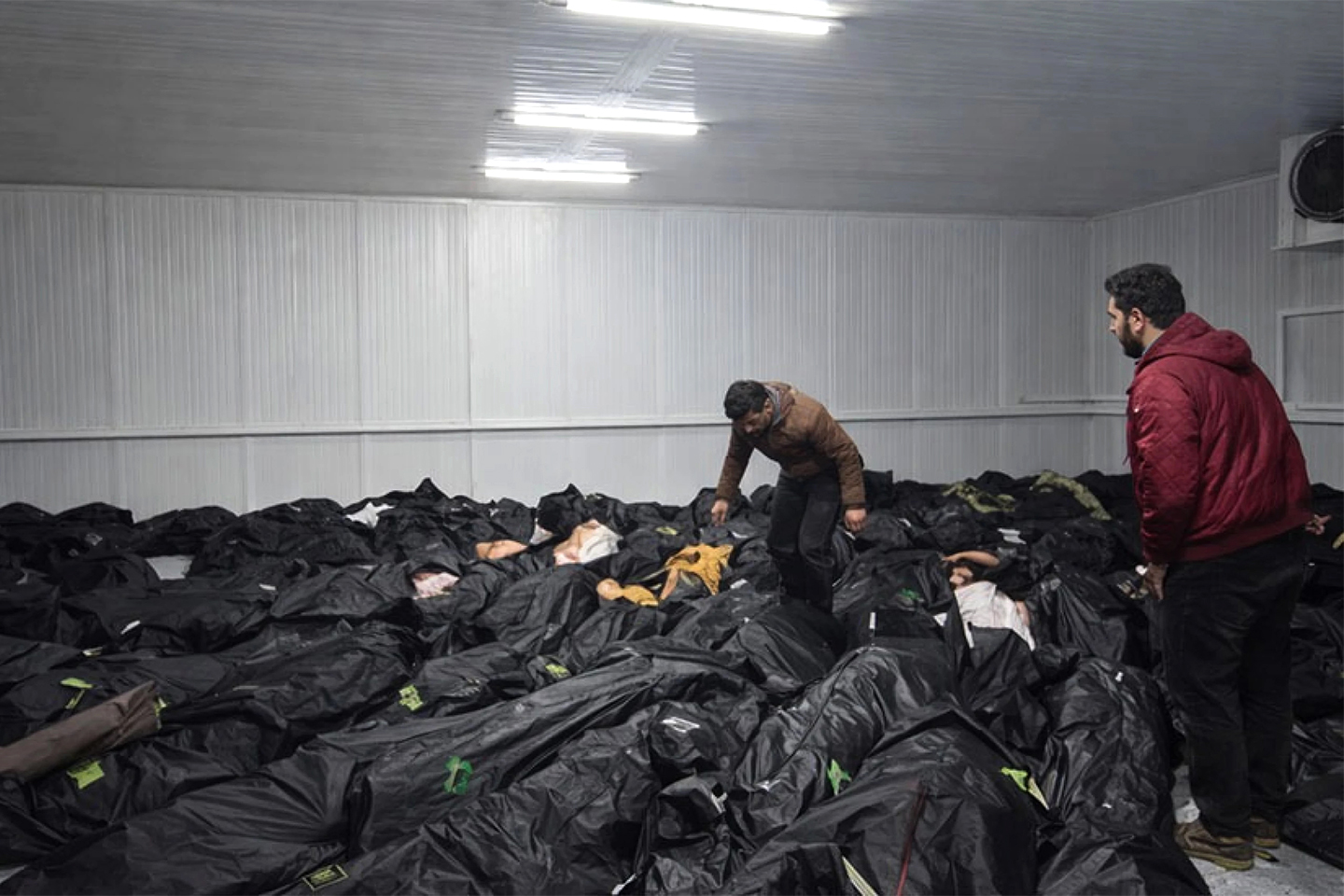
Bodies at the Kahrizak Forensic Medical Center, south of Tehran | ARCHIVE
HOSSEIN ZOGHI
La Directa
PUBLISHED:
FEBRUARY 19, 2026
The Islamic Republic of Iran, built on the fusion of political and religious power, represents one of the most prominent examples of religious despotism in the contemporary era. This regime, born out of the 1979 Revolution, has faced internal and external challenges for decades and is now immersed in a profound crisis. What occurred in January 2026—a bloody January marked by widespread massacres—reveals the regime’s total loss of legitimacy and the naked brutality of its structural violence.
Every time I try to communicate with friends in Iran, messages are delayed or lost. I feel the catastrophe in every silence. I have closely followed the protests of previous years, from the Student Movement of the 1990s to the “Woman, Life, Freedom” movement, and I have seen hope turn into fear. This bloody January is not just distant news: it is the stifled cry of people I know, of families waiting for answers that never come. This article examines the history of this government, its structural characteristics, and the current situation in February 2026, while underscoring the need for a transition toward a secular and federal system—one that recognizes Iran’s cultural and ethnic diversity and distributes power more equitably.
From Revolution to the Consolidation of Religious Power
The 1979 Revolution began as a massive mobilization promising independence, justice, and freedom from the Shah’s regime. Millions of Iranians participated in that movement, but after victory, religious forces led by Ruhollah Khomeini took control of the country. In the April 1979 referendum, the Islamic Republic was approved by a large majority, and the principles of velayat-e faqih, granting absolute power to the religious leader, became the core of the Constitution. This structure rejected the separation of religion and state, laying the foundations for the concentration of power in religious institutions.
In its early decades, the Iran-Iraq War (1980–1988) united the regime against an external threat, but it also devastated the economy and intensified repression against internal opponents, including leftists, liberals, and minorities. After Khomeini’s death in 1989, Ali Khamenei assumed leadership, and the Islamic Revolutionary Guard Corps consolidated its role as a fundamental pillar in maintaining power.
Reformist or moderate presidencies, such as those of Mohammad Khatami (1997–2005) and Hassan Rouhani (2013–2021), attempted to improve foreign relations and civil rights and to broaden the political spectrum. Yet internal reform efforts produced no lasting results. Whenever signs of openness appeared, the religious regime responded with harsher repression—from the persecution of press and activists under Khatami to unfulfilled promises and intensified crackdowns on protests under Rouhani. This pattern demonstrated that the structure of velayat-e faqih did not allow for fundamental change and neutralized any attempt at reform.
Recurring protests—from the Green Movement of 2009 to the nationwide demonstrations of 2017–2018, November 2019, and the 2022 “Woman, Life, Freedom” movement—reflected deep dissatisfaction with corruption, inequality, and repression. These waves of dissent were met with extreme violence, leaving thousands dead and detained.
Characteristics of Religious Despotism and Structural Challenges
As the central pillar of the system, velayat-e faqih places the Supreme Leader in a position virtually above accountability or oversight. Any dissenting voice is not merely seen as political criticism but as a threat to the essence of religion and the regime. This structure has subjected daily life to multiple layers of control.
Culturally and ideologically, religious laws such as the mandatory hijab, mass media censorship, control over educational content, and severe restrictions on art and literature have become tools to shape social thought and behavior. These controls have drastically limited women’s rights, marginalized religious and ethnic minorities, and reduced freedom of expression to near zero. As a result, questioning and diversity of thought are treated as sin or betrayal.
Politically and in terms of security, the Revolutionary Guard and the Basij paramilitary force have become the main arms for preserving power. Protests—large or small—are met with mass arrests, systematic torture, public executions, and covert killings. This repressive machinery not only eliminates opposition but also generates a climate of fear that destroys any possibility of independent organization.
Economically, the influence of religious foundations and entities tied to the Supreme Leader has diverted national wealth toward groups close to power. Structural corruption, mismanagement, monopolization of resources, and international sanctions have produced uncontrolled inflation and massive unemployment, making life extremely difficult for millions of Iranians. Public welfare has been sacrificed in favor of ideological and political priorities.
In foreign policy, support for regional groups and pursuit of the nuclear program have placed the regime in permanent confrontation with the West. Though sometimes presented as resistance, this confrontation has imposed enormous costs on the population, from increased sanctions to economic isolation and intensified internal pressures.
When legitimacy rests on a closed and non-negotiable ideology rather than the will of the people, every dissenting voice becomes an existential threat, perpetuating a cycle of repression and crisis.
An Unprecedented Massacre
In February 2026, Iran is still recovering from the massive national protests that began in late December 2025. Initially triggered by the dramatic collapse of the rial, runaway inflation, and a subsistence crisis, the wave quickly transformed into political demands to end religious rule. Protests spread across numerous cities and regions and were met with brutal repression: thousands were killed (including children) and countless others detained.
In early January, with the mass shutdown of internet and telecommunications networks and severe interference with Starlink satellites through jamming, an “operational blackout” was imposed on the country. This blockade created ideal conditions to conceal crimes and reduce the costs of repression, as condemned by human rights organizations. Although partial internet access has since returned, it remains unstable: extreme filtering, difficult-to-use circumvention tools, and increased digital surveillance through facial recognition and wiretapping. The few images that have emerged speak of unprecedented violence—direct live ammunition at close range, use of heavy weapons, piles of bodies, and rapid executions by military tribunals.
I remember an image that briefly circulated before being deleted: a schoolgirl in uniform sitting on the ground beside a pool of blood, staring into the void. I do not know whether it was real or symbolic, but it does not leave me. It represents what this regime can no longer hide: it is killing the future.
The regime no longer pretends legitimacy. Khamenei described the protests as an “enemy conspiracy” and declared he would not retreat. President Pezeshkian labeled demonstrators “foreign terrorists.” This language is rooted in physical extermination. The government blames the protests on Daesh, Israel, and the United States—a lie used to justify violence. Iraqi Shiite forces were also reportedly sent in support. Streets in cities such as Tehran, Kermanshah, Isfahan, Rasht, and Karaj smell of blood, and traces of repression are being erased. Doctors report massive numbers of bodies. People no longer dare to go outside.
Yet collective anger and grief persist. Teachers speak of murdered students; university students boycott exams in honor of the dead; society is filled with despair and rage. Repression continues: arrests of political activists—including reformists—threats against families, and mass death sentences issued in swift group trials. Street protests have decreased, but fear and anger remain. Internationally, rallies supporting the Iranian people have taken place in various cities worldwide, increasing pressure on the regime. The United States has sent thousands of Starlink terminals into Iran to maintain communications, and nuclear negotiations in Oman and Geneva continue amid high tensions.
Transition to a Secular and Federal Republic
Throughout its history, the Islamic Republic has demonstrated its inability to respond to demands for social justice, human rights, and cultural diversity. The current situation—deep economic crisis, widespread massacres, and loss of legitimacy—marks a turning point that could lead to fundamental change. This cruelty signals structural collapse; a regime that, like a wounded snake, has poured its venom onto its own people.
Iran’s future must be based on the separation of religion and state to guarantee civil liberties and equal rights. Moreover, a federal structure could recognize Iran’s ethnic and linguistic diversity—from Kurds and Baloch to Turks and Arabs—distributing power from the center to provinces and regions and avoiding excessive centralism. Such a model, preserving territorial integrity, would strengthen national unity and lead to a democratic, inclusive, and stable Iran. The collective demand is for freedom and democracy—an Iran where people freely choose between options such as a democratic constitutional monarchy or a secular republic.
Hossein Zoghi is currently part of the No Callarem–Barcelona Artists at Risk residency, which hosts artists in danger in their home countries.
PRESS TEXT:
Anatomia del col·lapse de la dictadura religiosa de l’Iran
Des de finals de desembre l’Iran es troba immers en una onada de protestes que ha estat reprimida de forma contundent pel règim religiós. La revolta ciutadana, però, és una més de les moltes mobilitzacions que el país viu de fa anys i que demostren que al llarg de la seva història el règim ha estat incapaç de respondre a les demandes de justícia social, drets humans i diversitat cultural
Cossos al centre mèdic forense de Kahrizak al sud de Tehran | ARXIU
La República Islàmica de l’Iran, construïda sobre la fusió del poder polític i religiós, representa un dels exemples més destacats de despotisme religiós en l’era contemporània. Aquest règim, sorgit de la Revolució de 1979, ha enfrontat durant dècades desafiaments interns i externs, i ara es troba sumit en una crisi profunda. L’ocorregut el gener de 2026, un gener sagnant amb massacres generalitzades, evidència la pèrdua total de legitimitat del règim i com de descarnada és la seva violència estructural.
Cada vegada que intento comunicar-me amb amics a l’Iran, els missatges triguen o es perden. Sento la catàstrofe en cada silenci. He seguit de prop les protestes d’anys anteriors des del Moviment Estudiantil dels anys 90 fins al moviment “Dona, Vida, Llibertat”, i he vist com l’esperança es transforma en por. Aquest gener sagnant no és només una notícia llunyana: és el crit ofegat de persones que conec, de famílies que esperen respostes que mai arriben. Aquest article examina la història d’aquest govern, les seves característiques estructurals i la situació actual el febrer de 2026, al mateix temps que subratlla la necessitat d’una transició cap a un sistema secular i federal un model que reconegui la diversitat cultural i ètnica de l’Iran i distribueixi el poder de manera més equitativa.
De la revolució a la consolidació del poder religiós
La Revolució de 1979 va començar amb una mobilització massiva que prometia independència, justícia i llibertat, de diversos sectors de la societat contra el règim del Shah. Milions d’iranians van participar en aquell moviment, però després de la victòria, les forces religioses liderades per Ruhollah Jomeini van prendre el control del país. En el referèndum d’abril de 1979, la República Islàmica va ser aprovada per una àmplia majoria, i els principis de l’anomenat velayate faqih, que atorguen el poder absolut al líder religiós, es van convertir en el nucli de la Constitució. Aquesta estructura va rebutjar la separació entre religió i estat, establint les bases per a la concentració del poder en mans de les institucions religioses.
La Revolució de 1979 va començar amb una mobilització massiva que prometia independència, justícia i llibertat
En les primeres dècades, la guerra Iran-Iraq (19801988) va unir al règim enfront de l’amenaça exterior, però al mateix temps va devastar l’economia i va agreujar la repressió contra opositors interns inclosos grups d’esquerra, liberals i minories. Després de la mort de Jomeini el 1989, Ali Jamenei va assumir el lideratge, i el rol de la Guàrdia Revolucionària Islàmica es va consolidar com a pilar fonamental per mantenir el poder.
Els períodes de presidències reformistes o moderades, com els de Mohammad Jatami (1997-2005) i Hassan Rohani (20132021), van intentar millorar les relacions exteriors, els drets civils i ampliar l’espectre polític, però en tots aquests anys, els esforços per reformes internes no van produir resultats duradors. Cada vegada que hi havia signes d’obertura, el règim religiós responia amb una repressió més dura i una restricció més gran, que anava des de la persecució de la premsa i els activistes amb Jatami, fins al fracàs a complir les promeses i l’enduriment de la repressió de les protestes amb Rohani. Aquest patró va demostrar que l’estructura del velayate faqih no permetia canvis fonamentals i neutralitzava qualsevol intent de reforma.
A l’Iran, les onades contestatàries són contestades amb violència extrema, deixant milers de persones mortes i detingudes
Les protestes recurrents des del Moviment Verd de 2009, les manifestacions nacionals de 2017-2018, les de novembre de 2019 i el moviment “Dona, Vida, Llibertat” de 2022 van reflectir un profund descontentament amb la corrupció, la desigualtat i la repressió. Aquestes onades contestatàries solien ser contestades amb violència extrema, deixant milers de persones mortes i detingudes.
Característiques del despotisme religiós i desafiaments estructurals
El velayate faqih, com a pilar central del sistema, situa al líder en una posició pràcticament per sobre de qualsevol rendició de comptes o supervisió. Qualsevol veu dissident no es considera només una crítica política, sinó una amenaça contra l’essència de la religió i el règim. Aquesta estructura ha sotmès la vida quotidiana de la població en múltiples capes de control.
En el pla cultural i ideològic, lleis religioses com l’ús obligatori del hijab, la censura massiva de mitjans, el control del contingut educatiu i restriccions severes a l’art i la literatura s’han convertit en eines per modelar la ment i el comportament de la societat. Aquests controls han restringit dràsticament els drets de les dones, han marginat les minories religioses i ètniques i ha reduït la llibertat d’expressió gairebé a zero. Com a resultat, ha sorgit una societat en la qual el qüestionament i la diversitat de pensament es consideren pecat o traïció.
Lleis religioses com l’ús obligatori del hijab, la censura o el control del contingut educatiu s’han convertit en eines per modelar la ment i el comportament de la societat
Des de la perspectiva política i de seguretat, la Guàrdia Revolucionària i la força paramilitar Basij s’han transformat en els braços principals per a preservar el poder. Les protestes, grans o petites, són contestades amb detencions massives, tortures sistemàtiques i fins i tot execucions públiques o assassinats encoberts. Aquesta maquinària repressiva no només elimina l’oposició, sinó que, generar un clima de por que destrueix qualsevol possibilitat d’organització independent.
En l’àmbit econòmic, la influència de fundacions religioses i entitats lligades al líder ha desviat la riquesa nacional cap a grups específics i pròxims al poder. La corrupció estructural, la mala gestió i el monopoli de recursos, juntament amb les sancions internacionals, han generat una inflació descontrolada i una desocupació massiva, fent la vida extremadament difícil per a milions d’iranians. En aquest context, el benestar públic ha estat sacrificat en favor de prioritats ideològiques i polítiques.
La corrupció estructural, la mala gestió i el monopoli de recursos, juntament amb les sancions internacionals, han generat una inflació descontrolada
En política exterior, el suport a grups a la regió i la persecució del programa nuclear han col·locat al règim en confrontació permanent amb Occident. Aquesta confrontació, encara que a vegades es presenta com a símbol de resistència, ha imposat costos enormes a la població: des de l’augment de sancions fins a l’aïllament econòmic i la intensificació de les pressions internes.
Quan les bases de la legitimitat s’assenten en una ideologia tancada i innegociable en lloc del poble, qualsevol veu dissident es converteix en una amenaça existencial, i el cicle de repressió i crisi es perpetua indefinidament.
Massacre sense precedents
El febrer de 2026, l’Iran encara es recupera de les protestes nacionals massives que van començar a finals de desembre de 2025. Aquesta onada va sorgir inicialment per la caiguda dràstica del rial, la inflació desbocada i la crisi de subsistència, però ràpidament es va transformar en demandes polítiques per posar fi al govern religiós. Les protestes es van estendre per moltes ciutats i regions del país i van ser enfrontades amb una repressió brutal: milers de persones van morir (inclosos infants) i un número incomptable va ser detingut.
A principis de gener, amb el tall massiu d’internet, xarxes de telecomunicacions i greus interferències dels nanosatèl·lits Starlink, mitjançant talls de l’anomenat jamming, es va imposar una “foscor operativa” al país. Aquest bloqueig va crear un escenari ideal per ocultar crims i reduir els costos de la repressió, tal com van condemnar organitzacions de drets humans. Encara que ara ha tornat un accés parcial a internet, continua sent inestable: filtrat extrem, eines d’evasió difícils d’usar i un augment en la vigilància digital amb eines com el reconeixement facial i les escoltes. Les poques imatges que han sortit a la llum parlen d’una violència sense precedents: trets directes amb munició real a curta distància, ús d’armes pesants, muntanyes de cadàvers i judicis de tribunals marcials per a execucions ràpides.
Les poques imatges que han sortit a la llum parlen d’una violència sense precedents: trets directes amb munició real a curta distància i ús d’armes pesants
Recordo una imatge que va circular breument abans de ser esborrada: una nena amb uniforme escolar asseguda a terra, al costat d’un toll de sang, mirant al buit. No sé si era real o simbòlica, però aquesta foto no m’abandona. Representa el que aquest règim ja no pot ocultar: està matant el futur.
El règim ja no fingeix legitimitat. Jamenei va qualificar les protestes com a “conspiració de l’enemic” i va afirmar que no retrocediria. El president Pezeshkian va titllar als manifestants de “terroristes estrangers”. Aquest llenguatge té la seva arrel en l’exterminació física. El govern atribueix les protestes a Daesh, Israel i els Estats Units, una mentida per justificar la violència. Forces xiïtes iraquianes també van ser enviades en suport. Els carrers en ciutats com Teheran, Kermanshah, Isfahan, Rasht i Karaj fan olor de sang i els rastres de repressió s’esborren. Els metges reporten volums massius de cadàvers. La gent ja no s’atreveix a sortir.
El règim ja no fingeix legitimitat. Jamenei va qualificar les protestes com a “conspiració de l’enemic” i va afirmar que no retrocediria
No obstant això, la ira i el dolor col·lectiu persisteixen. Mestres a les escoles parlen d’alumnes assassinats, estudiants universitaris boicotegen exàmens en honor a companys morts; la societat està plena de desesperació i ràbia. La repressió continua: detencions d’activistes polítics —inclosos reformistes—, amenaces a famílies i emissió massiva de sentències de mort en tribunals ràpids i grupals. Les protestes de carrer han disminuït, però la por i la ira romanen. A escala internacional, s’han realitzat concentracions en suport al poble iranià en diverses ciutats del món i això ha fet augmentar la pressió sobre el règim. Els Estats Units han enviat milers de terminals Starlink a l’interior de l’Iran perquè els manifestants mantinguin comunicació, i les negociacions nuclears a Oman i Ginebra continuen, encara que amb altes tensions.
Transició a una república secular i federal
La República Islàmica ha demostrat al llarg de la seva història que és incapaç de respondre a les demandes de justícia social, drets humans i diversitat cultural. La situació actual, amb una crisi econòmica profunda, massacres generalitzades i pèrdua de legitimitat, representa un punt d’inflexió que pot portar a canvis fonamentals. Aquesta crueltat és senyal d’un col·lapse estructural; d’un règim que, com una serp ferida, ha abocat el seu verí sobre el seu propi poble.
La República Islàmica ha demostrat al llarg de la seva història que és incapaç de respondre a les demandes de justícia social, drets humans i diversitat cultural
El futur de l’Iran ha de basar-se en la separació entre religió i estat per a garantir llibertats civils i drets iguals. A més, una estructura federal podria reconèixer la diversitat ètnica i lingüística de l’Iran —des de kurds i balutxis fins a turcs i els àrabs—, distribuint el poder des del centre cap a les províncies i regions, i evitant el centralisme excessiu. Aquest model que preserva la integritat territorial, enfortiria la unitat nacional i conduiria a un Iran democràtic, inclusiu i estable. La demanda col·lectiva és de llibertat i democràcia. La demanda vol que l’Iran sigui un lloc on la gent triï lliurement entre opcions com una monarquia constitucional democràtica o una república secular.
* Actualment, Hossein Zoghi forma part de la residència NoCallarem- Barcelona Artistes en Risc, que acull artistes en situació de perill als seus països
