


Link to original article:
https://nuevarevolucion.es/el-callejon-sin-salida-del-fascismo-religioso-en-iran/
AUTOMATED TEXT TRANSLATION:
The Dead End of Religious Fascism in Iran
The ideal model for tomorrow’s Iran is a federal and secular republic in which the definitive separation of religion and politics will guarantee the rights of all citizens.
By Hossein Zoghi | February 20, 2026
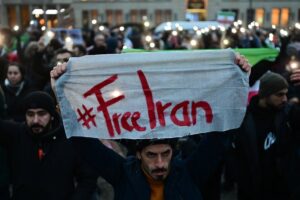
Iran today stands on the threshold of a historic transformation: between the ashes of religious tyranny and the true dawn of freedom. What the world has witnessed in recent months—especially from late December 2025 to February 2026—is not simply an explosion of economic discontent, but the culmination of decades of deep and inextinguishable resistance.
The system that has bound absolute power to religious dogma, after 47 years of rule based on Velayat-e Faqih (the guardianship of the Islamic jurist), has permanently lost its legitimacy. This is an internal and authentic struggle, in which the people of Iran have united against an internal ideological occupation and extreme economic corruption.
In certain analytical circles in Europe, the idea is still repeated that there is room for reformist “pragmatism” in Iran. But the reality on the ground screams the opposite: reformism within the Islamic Republic, under current conditions, is completely inoperative and fruitless. The structure of this despotic theocratic government—after more than 47 years of harsh repression against protests—has shown that it has no real capacity for change. Any attempt at opening, however small, is suppressed by the hard core of power as an existential threat.
The history of repression begins in the 1980s. From the first days after taking full power, the government eliminated its opponents by imprisoning countless activists and members of left-wing parties. The executions of leftist militants in 1981 and 1983 are unforgettable. And of course, the mass executions of 1988—the darkest moment of the Islamic Republic. That year, a large number of left-wing prisoners, without proven crimes, were executed in groups, and many were buried in unmarked mass graves.
This fierce repression, combined with the pressure of the eight-year war between Iran and Iraq, delayed protests against the despotism of the Islamic Republic. However, by the late 1990s protests resurfaced.
Let us review the milestones of these struggles: in 1999, the student movement protested after the closure of numerous reformist newspapers. They were met with brutal repression that left several dead and countless detainees. Images later revealed organized religious barbarity: in one case, students with their hands and feet tied were thrown from the roof of a university dormitory while their attackers shouted the names of Shiite imams.
Ten years later, in 2009, the people took to the streets to protest the election results. The choice was between reformists and forces tied to the regime’s hard-line core. The result was altered through organized fraud that overturned the popular vote. Citizens who supported reform were repressed in the most violent way possible. For months the protests were forcibly silenced, thousands were imprisoned, and a massive wave of Iranian migration began.
A decade later, two protest movements against deteriorating living conditions and the government’s inefficient economy were also harshly suppressed. In December 2017 and November 2019, people took to the streets demanding economic reforms. But the only response they received was bullets and prison.
Even the “Woman, Life, Freedom” movement—which erupted after the death of Mahsa (Jina) Amini in September 2022 and brought millions into the streets with unprecedented diversity, beauty, and courage—failed to force the regime into any real retreat. Women and girls in Iran, who stood at the forefront, faced savage repression: hundreds killed, thousands arrested, torture and executions.
Sharia laws continue to chain women; they have not been granted any new legal rights and even previous superficial concessions have been revoked. The struggle continues, but at a very high cost: mass arrests, crushing fines, social bans, and threats of flogging and prison.
Reports from organizations such as Amnesty International and Human Rights Watch show that this repression continued during the protests of 2025–2026, with thousands killed and tens of thousands detained. This bitter reality demonstrates that reform from within the system is not only impossible, but deepens the crisis.
The true “pragmatism” today is to accept the need for a complete systemic transition—one guided by a clear strategy: preserving national sovereignty, preventing foreign interference, and avoiding chaos or disintegration. The goal is to build a future where civil rights, territorial integrity, and an economy free from sanctions and structural corruption are guaranteed.
My analysis does not come from books or distance; I have felt it in my own flesh. In 2023, agents from the Intelligence branch of the Revolutionary Guard (Sepah) stormed the home of my wife and me. Eight agents took part in the raid, confiscating all our electronic devices. After that, for months, we were constantly going back and forth between an intelligence building and the Evin prosecutor’s office.
This raid and harassment occurred simply because we published my wife’s books clandestinely and uncensored, and because of our writings and interviews about censorship and freedom of expression. Just like that, our lives were changed.
Now the people, after all their bitter experiences with lack of freedom, the terrible economic situation, and the disastrous state of water, electricity, gas, and air, have reached the limit of their endurance. They are determined to overthrow this religious fascist government.
This antifascist struggle has deep resonance with the historical memory of the Spanish people against Franco, and with resistance movements in Palestine and Latin America. We know that freedom is not negotiable with any dictatorship, whether it wears a military uniform or religious robes.
We also know that international sanctions have placed overwhelming pressure on the population, but structural corruption and the economic monopoly held by the Revolutionary Guard have turned these sanctions into a weapon against the disadvantaged classes. The regime uses this blockade to strengthen its monopolies, while ordinary people pay the price.
It is often warned that the fall of the regime could lead to a new form of despotism. Our answer is simple: the Iranian nation has lived more than four decades under one of the most violent forms of religious fascism and has experienced all its dimensions and dangers firsthand.
Today’s Iranian society is conscious, plural, and mature, and it will no longer accept any tyranny under any name. Forty-seven years of repression have produced deep political maturity that will prevent history from repeating itself.
After the collapse, Iranians will be able to choose freely between options such as a democratic constitutional monarchy or a republic. Our focus is on preventing disintegration, strengthening national unity, and resisting external pressure.
As an intellectual who has experienced years of repression, I believe the ideal model for tomorrow’s Iran is a federal and secular republic. The definitive separation of religion and politics will guarantee the rights of all citizens, especially equality for women.
A federal structure is not a threat, but the strongest guarantee for preserving territorial integrity. The unity of Iran should not be imposed by force from a despotic center; it must be a “voluntary union” based on justice.
A fair distribution of power among Kurds, Baluchis, Turks, Arabs, Persians, and others will eradicate despair and close the path to separatism. This model could be the key to freeing the country from sanctions and achieving real national sovereignty.
The Islamic Republic has turned Iran into a prison of thought and a battlefield against modernity, but the fire of freedom that has been lit cannot be extinguished.
The progressive world must not look at Iran through the lens of a Realpolitik based solely on interests. They must listen to the voice of a nation that has paid the highest price for freedom.
The end of religious despotism is not only the desire of Iranians; it is a necessity for global peace and justice—provided that this change is authentic, independent, and restores sovereignty to the people.
In accordance with the right of reply, this article responds to the piece “For a Pragmatic View Toward Iran,” by Bárbara del Arco Pardo, which refers to the author.
Hossein Zoghi (born in 1980 in Tehran) is an Iranian journalist, theater director, and actor.
