


SOURCE: El Diario by Hossein Zoghi, 28.2.2026 https://www.eldiario.es/internacional/huchas-forma-granada-misiles-patio-he-vivido-guerras-iran-ahora-fuera-dificil_129_13029689.html
AUTOMATED TEXT TRANSLATION:
Piggy Banks Shaped Like Grenades and Missiles in My Yard: I Have Lived Through Every War in Iran, but Now I Am Outside — and This Is the Hardest One
The Iranian journalist and theatre director Hossein Zoghi (Tehran, 1980) recalls the wars he has endured firsthand in Iran and how he now follows the current aggression from exile, after leaving the country a few months ago.
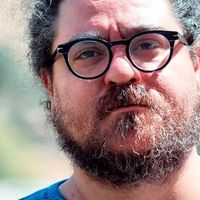
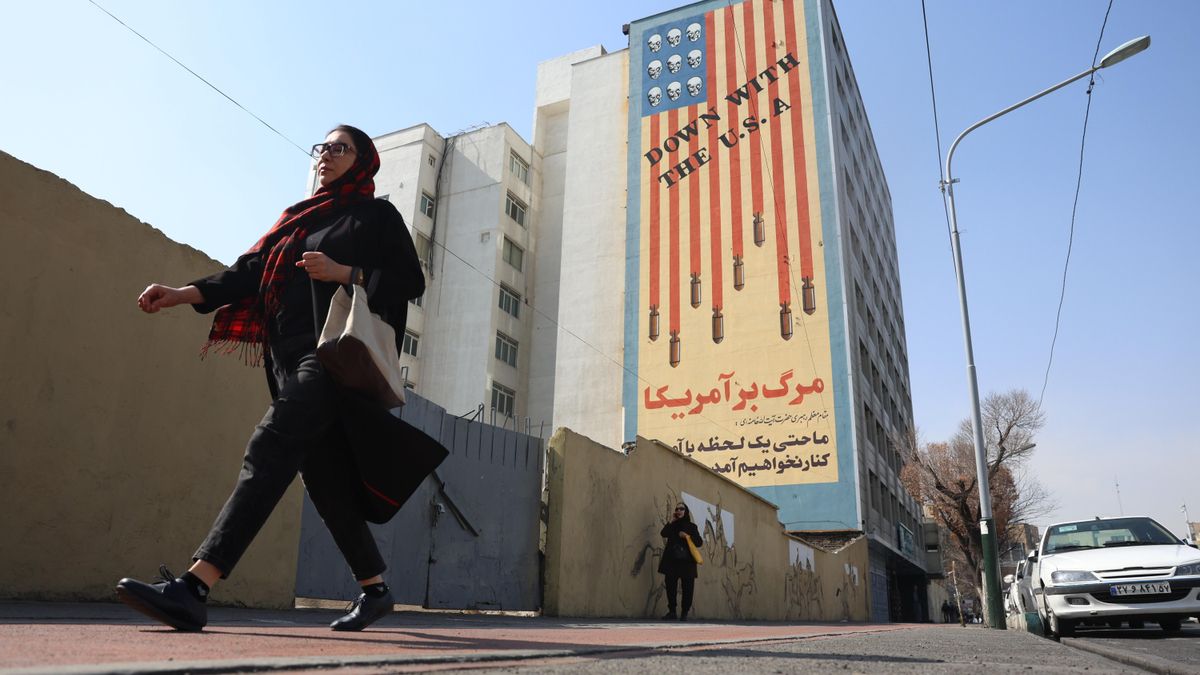 A woman walks past an anti-U.S. mural on a building in Tehran on February 23. EFE/EPA/ABEDIN TAHERKENAREH
This Saturday morning, when I read the news of the attack by the United States and Israel against Iran, the first thing that came to mind was that the government would probably cut the internet. I quickly sent a message to a friend who is living in my house in Iran. He still had a connection; he told me he had heard two explosions near the house and that the cats, frightened, had hidden under the sofas. He was afraid too.
Shortly afterward, communication was cut off. Once again, the people of Iran are facing an internet blackout while enduring American and Israeli bombs and missiles.
At moments like this, I cannot stop thinking about how much war and bloodshed we have seen in Iran.
Winter 1987
December 1987. Iraq attacked Tehran with its planes. It was my first direct encounter with war.
I was born just as the Iran–Iraq War began. The first eight years of my childhood were spent in the midst of war. Although I do not remember Saddam Hussein’s initial attack on Tehran, I vividly remember that damned, bloody winter.
We heard a terrifying noise, and the windows of our house shook violently. We followed war news on television. At school, we were constantly told about the war, which the regime called the “Sacred Defense.” I remember that every week we were given a plastic piggy bank shaped like a hand grenade. We had to return it full the following week so the money could be sent to the fighters. We were also asked to write letters to soldiers at the front, telling them we were thinking of them.
Several members of my family were at war. One of my uncles was shot in the early days of the conflict; the bullet entered the back of his neck and, luckily, exited. He spent months in hospital and never returned to the front. A cousin of mine, Behrouz, who had been lively and joyful as a child, returned from war psychologically shattered. I used to write him letters at school, and years later I learned my aunt had kept them. He still carries the trauma.
The winter of 1987 was the first direct blow of war for me — an eight-year-old child. Many people fled Tehran. We stayed. My father was in the military and had to work; my mother insisted: “Our home is here!” She has always been strong.
But two months later everything changed. Iraqi missiles were launched at Tehran. It was late January 1988, around noon. We lived in a large, traditional house with rooms facing a central courtyard. I was half-asleep when suddenly the world turned upside down. There was an explosion so terrible that I jumped up and, out of fear, wet myself. The window above me shattered; glass fell over my body. My mother rushed in, grabbed me, and ran to the courtyard.
There, we heard something crash behind us. A large red piece of metal had landed just meters away in our yard — part of a missile. We stood paralyzed.
Even my brave mother could not endure more. She packed everything, called my father, and told him we had to leave Tehran. We moved for months to Taleghan, in the Alborz mountains. The wound of that moment has never left me.
Those grenade-shaped piggy banks were the seeds of the war we are suffering again today. I have lived my 45 years in Iran, endured all these miseries — but this time I follow the news from outside my country. Believe me, this time it is harder than ever.
Autumn 2024
Friday, October 25. A cold night in Tehran. I couldn’t sleep. I read, played with the cats, finally fell asleep around 4 a.m. An hour later, explosions woke me. I thought they were fireworks for a religious occasion and went back to sleep. At 6 a.m., my phone was flooded with messages. Israel had attacked Iran. The first strike happened only a few streets from where we lived.
For twelve days, explosions shook our home. At night, we heard air defenses and the strange hum of drones. Mahsa, the cats, and I grew accustomed to the sounds.
We rarely left the house. The government cut the internet; we relied on television. We slept in shifts so as not to miss news updates.
We thought that having survived rockets and bombings before, we could endure this. But when it ended, the emotional crisis began. A deep wound opened in our psyche. I believe we will never forget it.
Winter 2026
Nearly fifty days have passed since the massacre of protesters in the streets. Severe repression against the people — brutal and unbelievable. We are glued to our phones, compulsively checking the news.
And now, this Saturday, Israel and the United States attack again. I have lost count of the wounds we have received. I read that in Minab, a girls’ school next to a Revolutionary Guard naval base was targeted; dozens of minors were killed.
Those grenade piggy banks were the seeds of today’s war. I have lived my entire life in Iran, endured all its suffering. But now I follow events from exile. This time it is more difficult than ever.
What will this war bring the people of Iran besides destruction? A regime change? Perhaps. But the defenseless Iranian people are being killed again — fifty days ago by the dictatorship of the Islamic Republic, and now by Israeli and American missiles and bombs. What fault is it of the Iranian people?
What will happen this time?
It strikes me as strange that most of my memories of war are tied to the cold seasons of the year.
Hossein Zoghi (Tehran, 1980) is an Iranian journalist and theatre director. His career in various newspapers has been marked by censorship and the closure of media outlets. In theatre, he is known for his political and underground productions, for which he was banned in his country. He currently resides in Catalonia as an Artist at Risk (AR) and NoCallarem resident.
PRESS TEXT:
Huchas con forma de granada y misiles en mi patio: he vivido todas las guerras en Irán, pero ahora estoy fuera y esta es la más difícil

Este sábado por la mañana, al leer la noticia del ataque de Estados Unidos e Israel contra Irán, lo primero que me vino a la mente fue que, probablemente, el Gobierno cortaría internet. Rápidamente le envié un mensaje a un amigo que vive en mi casa en Irán. Todavía tenía conexión; me dijo que había escuchado dos explosiones cerca de la casa y que los gatos, asustados, se habían escondido debajo de los sofás. Él también tenía miedo.
Poco después, la comunicación se cortó. Una vez más, el pueblo de Irán se enfrenta al corte de internet mientras padecen bajo las bombas y los misiles estadounidenses e israelíes. En estos momentos no puedo parar de pensar en cuánta guerra y derramamiento de sangre hemos visto en Irán.
Invierno de 1987
Diciembre de 1987. Irak atacó Teherán con sus aviones. Fue mi primer encuentro directo con la guerra.
Nací justo cuando empezó la guerra entre Irán e Irak. Los primeros ocho años de mi infancia los pasé en medio de la guerra. Aunque no tengo recuerdos del ataque de Saddam Hussein a Teherán al comienzo de la guerra, recuerdo muy bien aquel maldito invierno sangriento. Todos nosotros, mis hermanos y mi madre, estábamos de pie en el patio mirando las ventanas rotas del edificio. En ese momento, el sonido violento de algo golpeando el suelo detrás de nosotros nos hizo darnos la vuelta. ¡Un gran trozo de metal rojo había caído a pocos metros de nosotros, en el suelo de nuestro patio! Estábamos paralizados por el miedo y el shock. No podíamos respirar. Era un pedazo de un misil, quizás la parte trasera que se había desprendido y había aterrizado en nuestro patio.
Os había dicho que tengo una madre valiente, pero ella tampoco pudo aguantar más. En ese mismo instante entró corriendo en casa, recogió todas las cosas, llamó a mi padre y le dijo que teníamos que irnos de Teherán. Vivimos durante unos meses en nuestro pueblo, en un lugar entre las montañas de Alborz llamado Taleghan. Créanme, ¡la herida de aquel suceso aún permanece en mi mente!
Otoño de 2024
Viernes 25 de octubre. Una noche algo fría en Teherán; el insomnio se apoderó de mí. Leí un libro, jugué con los gatos. Estuve despierto casi hasta las 4 de la mañana del 26 de octubre. Por fin, me quedé dormido. Una hora después oí varios estruendos fuertes. Pensé que tal vez era el sonido de los fuegos artificiales del Gobierno por alguna ocasión religiosa y me volví a dormir. A las 6 de la mañana me despertó el sonido constante de los mensajes en mi móvil. Amigos desde fuera de Irán me preguntaban preocupados. Otros en Teherán preguntaban si Mahsa y yo estábamos bien. Encendí la televisión y me enteré de que Israel había atacado Irán. El primer ataque se produjo a unas pocas calles de donde vivimos.
Desde esa mañana hasta 12 días después, casi todos los días varias explosiones enormes hacían temblar nuestra casa. Desde el atardecer en adelante, podíamos oír el sonido de las defensas aéreas y el extraño zumbido de los drones. Mahsa, los gatos y yo nos acostumbramos a los ruidos a partir del segundo día.
Apenas salíamos de casa, excepto para hacer la compra en el supermercado que estaba al lado. El Gobierno había cortado internet y solo veíamos la televisión. Dormíamos casi por turnos para no perdernos ninguna noticia.
Pensábamos que, habíendo vivido ataques con cohetes y bombardeos en Teherán podríamos soportar este ataque. Pero cuando terminó, nuestra crisis emocional apenas comenzaba. Esta vez se abrió una herida profunda en nuestra psique. Creo que nunca olvidarmeos aquello.
Invierno de 2026
Han pasado casi 50 días desde la matanza de manifestantes en las calles. ¿Cómo se puede olvidar esto? Una represión severa contra el pueblo. ¡Increíble y brutal! Estamos como locos con la cabeza metida en el móvil para revisar las noticias. Se ha convertido en una enfermedad.
Pero este sábado me desperté a las 7 de la mañana y vi que Israel y Estados Unidos estaban atacado Irán. ¡He perdido la cuenta de las heridas que hemos recibido! He leído en las noticias que en Minab, una ciudad al sur de Irán, una escuela de niñas situada junto a una base naval de la Guardia Revolucionaria ha sido blanco de un ataque con decenas de menores asesinadas.
Aquellas granadas que nos daban como huchas eran la semilla de la guerra que hoy volvemos a sufrir. He vivido mis 45 años en Irán, he pasado por todas estas miserias, pero esta vez sigo las noticias lejos de mi país. Créanme, esta vez es mucho más difícil que nunca.
¿Qué traerá esta guerra para el pueblo de Irán, además de destrucción? ¿Un cambio de régimen? ¡Tal vez! Pero el pueblo indefenso de Irán vuelve a ser asesinado. ¡Hace cincuenta días por la dictadura de la República Islámica y esta vez por los misiles y bombas israelíes y estadounidenses! ¿Qué culpa tiene el pueblo iraní?
¿Qué pasará esta vez?
Pienso en lo extraño que es que la mayoría de mis recuerdos de la guerra estén relacionados con las estaciones frías del año.
Hossein Zoghi (Teherán, 1980) es periodista y director de teatro iraní. Su trayectoria en diversos diarios ha estado marcada por la censura y la clausura de medios. En el ámbito escénico, destaca por su teatro político y clandestino, por el cual fue vetado en su país. Actualmente reside en Cataluña como Artist at Risk (AR) and Nocallarem.
