


Source: TFP by Mahsa Mohebali, 3.3.2026
Press text:
Mahsa Mohebali: Divorce and War
The acclaimed Iranian writer in exile on her arrest and interrogation by the regime in Tehran and why “Bombs will not teach us how to hear one another.”
MAR 03, 2026
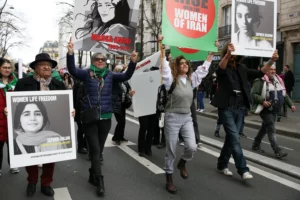
A “Woman, Life, Freedom” demonstration in honor of 22-year-old Mahsa Amini who died in custody after her arrest in Tehran for allegedly violating Iran’s mandatory hijab laws, Paris, March 8, 2024. (Photo by Jeanne Menjoulet)
By Mahsa Mohebali
As American bombs fall on my home country of Iran, I find myself thinking about my failed marriage.
It was 2001. I wanted a divorce. My husband refused.
A life that had begun with love and urgency had stalled. He hid behind his Islamic and legal rights. “I won’t divorce you until your hair is the color of your teeth,” he said — until I was old.
In the Islamic Republic, a woman is treated as a man’s property. She cannot initiate divorce except through narrow and humiliating legal maneuvers, most commonly by demanding her mehrieh, the dowry promised at marriage. I refused to turn myself into a financial transaction. I would not use the law’s own cynicism to buy my freedom.
I tried persuasion. I sent intermediaries. Two years passed before he relented, granting me notarized power of attorney so I could go forward with the divorce myself. In court, the judge — a mullah — flipped through the file and asked, “What did you do to make your husband want to divorce you?”
“No,” I said. “I want the divorce.”
I placed my published novels on his desk. “I am a writer. We did not have mutual understanding.”
He glanced at the books with contempt and pushed them aside. “It’s these very things you do that make husbands divorce you.”
I said nothing.
Years later, in 2016, four young clerics asked me to lead a private fiction workshop. They promised to come in civilian clothes so I would feel at ease. I hesitated that day: Should I wear a hijab? I had never sat without a headscarf, unveiled, before a mullah. In the end, I left it off. They were coming to my home. I would be myself.
Subscribe
They arrived in jeans and bright T-shirts — pink, lemon yellow — their beards trimmed like fashion models. They brought nonalcoholic beer. We sat on the floor, smoking cigarettes and arguing about literature. Sometimes one brought his girlfriend. On religious holidays, they apologized for missing class; they had been sent by the seminary to deliver sermons.
It was hard to imagine these same young men — occasionally scratched by my cat, Charlie — preaching from a pulpit. Yet one of them became a novelist. A good one. He was eventually defrocked and expelled. Now he drives a taxi to survive. He still writes. I saw on Instagram that he attended protests on Jan. 8 and 9. He could be killed at the next one.
Recently, I watched a video of monarchists gathered in the United States. An Iranian singer shouted into a microphone: “We will hang all the mullahs by their asses from the trees of Pahlavi Street.” As he spoke, I saw the faces of my former students — those young clerics — dangling from trees.
For years, many of us tried to widen the circle of listening. To hear the opposing voice. To resist dividing society into insiders and outsiders. Today we are dismissed as reformists, as leftists, as naïve. Everything has lost its meaning.
Iranians have endured invasions for centuries — Mongols, Turks, Arabs. Often, instead of annihilating the invader, we absorbed him. Our grand viziers taught the conquerors the rituals of statecraft until they, too, became Iranian. That instinct — to educate rather than eradicate — may be our greatest strength.
But it can also look like weakness. The Sassanid Empire fell to Arab armies between 633 and 651 CE, in some cases throwing open the gates due to discontent with their own rulers. Now, once again, many eyes turn to the sky and outside forces for change. Will U.S. President Donald Trump’s “Operation Epic Fury” rescue the Iranian people?
It is an ancient posture: the human who prays for lightning to strike his enemy. But lightning follows its own physics. It does not answer prayer. Nor does American military action answer the needs of Iranian protesters. Nations act on interests, not solidarity. The calculus of U.S. strategy in the region is complex and cold. Whatever its rhetoric, it is not about my freedom, or my students’ freedom, or the young woman who removes her hijab in defiance.
Three years ago, the slogan “Woman, Life, Freedom” rang out after the death of a young Kurdish woman in the custody of Iran’s Gasht-e-Ershad (Guidance Patrol), better known as the morality police. Just 22 years old, Mahsa Amini, whose Kurdish first name was Jina, died in Tehran on Sept. 16, 2022, after being detained for allegedly violating mandatory hijab laws. Demonstrations honoring her sprang up in Iran and across the globe in places like New York, Paris, and Berlin. For a moment, we believed we were witnessing the first women-led revolution in the Middle East against a theocracy. Each fallen hijab felt like a small emancipation.
Iranian women have borne a double burden for 47 years: compulsory hijab, unequal custody rights, restrictions on travel, barriers to education and employment. Yet even now, in the rhetoric of some opposition groups, I hear the same hunger to silence the “other.” Monarchists chant, “Death to traitors.” Democracy advocates call them fascists. Before power is even won, the language of execution returns.
Where do I stand? If the Islamic Republic survives, I cannot return home. My novels are banned. I would go straight to prison for what I have written — including this essay. If monarchists prevail, perhaps that same singer would hang me from a tree for criticizing their prince. If leftists take power, some would condemn me for portraying their safe houses and their failures in fiction.
Four years ago, on a hot summer afternoon, eight men and one woman from the Islamic Revolutionary Guard Corps suddenly entered my apartment with a warrant to search the premises and arrest me. The charges: disturbing public opinion, spreading lies, and acting against the regime. How? They said it would be revealed later. But it never was. In the following days, they scoured all my writing, every note, post and story on Instagram and Facebook, every book, everything on my laptop. Half-finished novels, half-finished screenplays, my story outlines.
As humiliating as the raid on my apartment was, it didn’t end there. I was brought to Tehran’s notorious Evin prison for further interrogation. The entire experience was maddening. I once slit my wrist in anger before questioning. After 20 sessions, my interrogator told me we had progressed only 10 percent. I wrote 140 pages in response to their questions; my fingers cramping from the strain. Nevertheless, I tried to speak to the human being inside the torturer. I did not want to erase him in my mind. “You are a human, and I am a human,” I explained. “It is not right for one to treat the other this way.”
It did not work.
But I still believe that the alternative — eliminating the other — is worse.
When belief hardens into war, the first casualty is the possibility of living together. We seem condemned to fight one another—mullah against monarchist, leftist against liberal, exile against dissident—at home. We forget how quickly crowds once saw Ayatollah Khomeini’s face in the moon. We forget how easily devotion turns to repression.
And now, as explosions light the sky over Iran, I return to the question that began this reflection: What is my share? What is ours?
I know only this: Bombs will not teach us how to hear one another. They will not build the habit of pluralism that we have never fully learned. They will not protect the young cleric who writes novels, or the unveiled girl who chants for freedom, or the writer who refuses to be silent.
American missiles, like lightning, may strike their targets. But they cannot rescue us from ourselves.
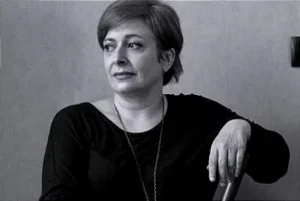
Iranian writer Mahsa Mohebali, currently in exile, is one of her country’s most acclaimed writers. Notable among her work is the novel In Case of Emergency(translated by Mariam Rahmani), a New Yorker Best Book of 2022. She is also author of the novella Lovemaking in the Footnotes, winner of the Houshang Golshiri Literary Award, and the novels Tehran Girl and Téhéran Trip. Her books have been translated into English, Italian, French, Polish, Turkish, and other languages. She is also a literary critic and celebrated screenwriter, working on the films Ages of Love and 19. The regime in Tehran has banned publication and reprinting of her work.
