


Source:
El Mundo (La Lectura section) by Vanessa Graell, 2 April 2026, Link to original article: https://www.elmundo.es/la-lectura/2026/04/02/69bd8d9d21efa0af598b45a5.html
Automated Machine translation:
The NGO Saving Artists at Risk:
“The Number of Authoritarian Governments Is Growing Worldwide While Democracy Is in Decline”
Based in Helsinki and supported by a global network of collaborators, Artists at Risk (AR) has helped nearly 1,200 artists leave their home countries to escape censorship, government persecution, or even death sentences. “We fight for freedom of expression,” the organization declares.
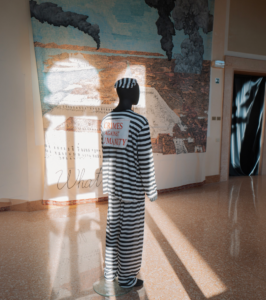
‘Crimes Against Humanity’ (2024) by Zimbabwean artist Nkosolathi Moyo, exhibited at the Venice Biennale.
By Vanessa Graell
Updated Thursday, April 2, 2026 – 00:10
Afropop rapper and singer Lil Balil, threatened with death in Somalia by jihadist groups for having what they deemed an overly Western style. Kurdish artist Zehra Doğan [not AR], imprisoned for drawings depicting the Turkish army’s brutal destruction of Kurdish towns. Popular Vietnamese singer Mai Khoi, forced into exile for criticizing the censorship of the Communist government. Performance artist Elyla Sinvergüenza (the stage name of Fredman Barahona) [not AR], who uses drag—including creating a dress made of machetes—to challenge President Ortega’s repression in Nicaragua. Omaid Sharifi [not AR], who painted human rights murals in Kabul and had to flee Afghanistan before the Taliban could execute him. Sudanese dissident Khalid Albaih [not AR], persecuted for his political cartoons. Or Russia’s Pussy Riot, including the dramatic escape of Masha Alyokhina, who disguised herself as a food delivery worker in a bright green uniform and motorcycle helmet to evade police surveillance in Moscow before escaping through Lithuania.
All are artists at risk who fled their countries to avoid censorship, political persecution, or outright execution. All were assisted by Artists at Risk (AR), an NGO founded in Helsinki by Marita Muukkonen and Ivor Stodolsky, who are far more than simply art curators and activists.
“Most of our artists want to return home. They don’t come to Europe to stay—they come so they can continue working for democracy in their own countries. Protecting them doesn’t mean bringing more immigrants to Europe; it means investing in the future democratic leaders who can rebuild their societies.”
Marita explains this at Barcelona’s Centre for Contemporary Culture (CCCB), one of several cities hosting exiled artists through the organization’s residency program. Fresh from Nairobi, the Artists at Risk (AR) directors stopped in Spain to participate in a human rights discussion during the Irídia Festival. Also attending were two of their Iranian residents: writer Mahsa Mohebali, who was placed in a village in the Pyrenees, and theatre director and journalist Hossein Zoghi.
“Right now, the media spotlight is on Iran because its instability affects the West through rising oil prices and flight cancellations,” Ivor says with a sigh. “But in the Democratic Republic of the Congo, a bloody and brutal civil war is raging. Sudan is experiencing its second genocide in ten years against Black Africans, with armies financed by Arab states. There are around 15 million displaced people, between 80,000 and 150,000 civilian deaths, and almost no media coverage.”
Beside him, Marita adds:
“In Afghanistan, the Taliban have passed a law that effectively legalizes the enslavement of women. Husbands may beat their wives, and as long as they don’t break any bones, it isn’t considered a crime. They are also forcing women to wear an eye patch beneath the burqa because, they claim, ‘women don’t need more than one eye to see where they’re walking.’ It’s pure torture—and nobody is talking about it.”
Although Artists at Risk (AR) managed to evacuate more than a hundred Afghan artists [not accurate] after the Taliban returned to power in 2021, the organization says that rescuing people from Afghanistan has now become “an impossible mission.” The problem is not only the already daunting logistics of getting people out of the country, but also the fact that no European country currently issues visas to Afghan nationals.
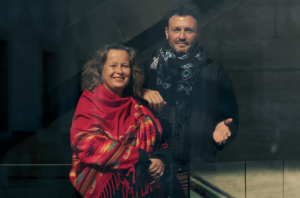
Marita Muukkonen and Ivor Stodolsky, directors and founders of Artists at Risk (AR), at Barcelona’s Centre for Contemporary Culture (CCCB).
Photo: Gorka Loinaz / Araba Press.
“Solidarity is selective,” Ivor says. “Europe provides extensive funding and residency permits for Ukrainian artists, but almost nothing for Sudanese artists, for example. Afghanistan faces a complete wall. The actual number of artists we can help depends more on politics and funding than on the severity of the crises in their respective countries.”
Marita adds—complementing Ivor as if they were yin and yang:
“European visa policies are the biggest obstacle. Germany promised to evacuate 1,000 Afghans per month who had assisted its embassy [German forces], but over two years it relocated fewer than 1,000 people in total. The program has now been shut down.”
Although Marita and Ivor come from the art world, they speak more like political scientists or diplomats—albeit without the suits. At times, their work reaches further than that of the European Union or Western governments. They know by heart the human rights statistics for many of the world’s most repressive regimes.
Ivor offers one example:
“Egypt has between 60,000 and 100,000 political prisoners. No exact figure exists because the government works hard to conceal the true number.”
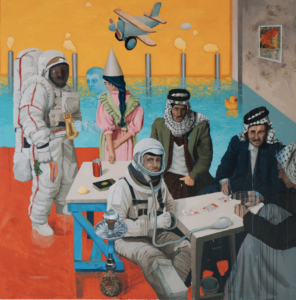
The painting ‘Unfair Game’ by Iraqi artist Saddam Jumailye.
Egypt is a case that remains a painful wound for them—or rather, an open scar: the case of poet Galal El-Behari. He is only 36 years old and has already spent eight years in prison for writing the song Balaha (2018), a satire of President El-Sisi, performed by Ramy Essam, known as the “Singer of the Revolution” after Irhal became the anthem of the Tahrir Square protests against dictator Hosni Mubarak in 2011.
El-Behari was sentenced to three years in prison by a military court—on charges including blasphemy, terrorism, and insulting the army, among others—but after completing his sentence, he was kept in indefinite pretrial detention.
Although Artists at Risk (AR) managed to help Ramy Essam leave Egypt, with El-Behari they were stopped by a single missing document.
“He passed every airport checkpoint, but he was missing one final stamp and had to go back. They arrested him right there. We were so close…” Ivor says regretfully.
Even with international pressure and support from PEN, the worldwide association of writers, El-Behari has not been freed.
Artists at Risk(AR) collaborators were, however, able to smuggle a pen into his prison cell [AR never claimed this], allowing him to write his long and poetic Letter from Tora Prison, published several years ago. Here are some translated lines:
“I laugh at a song
they call ‘criminal,’
a song that led them
to build a hundred barricades (…)
They want to hide the past
behind locks and chains (…)
They can take away one square from us,
but there are thousands and thousands more.
We are not afraid.”
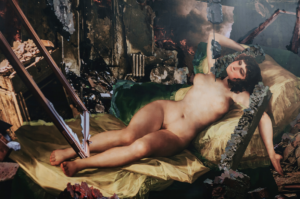
‘New Maja of Goya’ (2024), by Ukrainian artist Nikita Kravtsov.
The origins of Artists at Risk (AR) were, precisely, in the squares of the Arab Spring, where artists who painted murals calling for freedom, wrote songs about equality, or fought for genuine elections were being persecuted.
Marita and Ivor organized an exhibition in Helsinki titled ** Back to the Square ** and began creating residency programs for some North African artists. They formally established the NGO in 2013 as a modest Finland-based organization.
Over the years, it has helped nearly 1,200 artists—half of them from Ukraine—and expanded its network of collaborators around the world, with more than 340 partners providing safe spaces and residencies, from Mombasa to Basel.
“Barcelona is one of our main hubs,” they emphasize. “Today, residents receive support from the City Council, the Catalan government, and the Foreign Affairs Committee of the Spanish Congress in Madrid. We also have European funding, private donors, and our own global network. It’s a whole patchwork of financing designed to ensure the project continues when governments change,” Ivor explains.
Over the past five years, their work has expanded significantly. They even inaugurated their own pavilion at the 2024 Venice Biennale, with support from UNESCO [the first AR Pavilion was actually at the Athens Biennale in 2017, parallel to documenta 14].
At Palazzo Zorzi, they presented works by around twenty artists, but the exhibition continues online in virtual form: anyone can explore its galleries and immerse themselves in the artworks and videos [https://virtual.artistsatrisk.org/].
These include ** New Maja of Goya **, a reinterpretation by Ukrainian artist Nikita Kravtsov that places Goya’s famous Maja figure amid the ruins of a devastated Ukraine.
Another work is the mannequin wearing a prisoner’s uniform with the words “Crimes Against Humanity” written on its back by Nkosolathi Moyo—a prison jumpsuit that the artist sent to Zimbabwean President Robert Mugabe as a birthday gift in 2016.
“Mugabe opened it live on television,” Ivor laughs.
Moyo became a target afterward, remaining at risk until Mugabe’s overthrow in 2017.
Behind every artwork lies an entire story.
“In fact, we keep adding new works to the virtual pavilion. Although we would love to have a permanent physical exhibition space. Maybe it could be in Barcelona,” Ivor says with a wink.
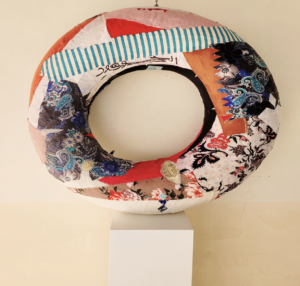
‘Whale-Borders’, a ceramic life buoy inspired by those used in maritime rescue operations, by Mohamen Alhassan.
Every year, Artists at Risk (AR) receives hundreds of applications, which are thoroughly reviewed by a specialized local team following a rigorous assessment protocol.
“The number of authoritarian governments is growing around the world while democracy is retreating,” Marita notes.
They have even received applications from artists in the LGBTQ+ community from… the United States.
“Our work is neither left-wing nor right-wing. It is a universal defense of freedom of expression and human rights, without exceptions,” Marita and Ivor say.
There are more and more people involved in Artists at Risk(AR), and they are reaching farther and farther to protect those who dare to raise their voices for freedom and fight against brutality.
Original Press Text:
La ONG que salva a artistas en peligro: “El número de gobiernos autoritarios crece en todo el mundo mientras la democracia retrocede”
Con base en Helsinki y una red de colaboradores que se extiende por todo el mundo, Artists at Risk (AR) ha ayudado a cerca de 1.200 creadores a abandonar sus países para evitar la censura, la persecución gubernamental o la pena de muerte. “Luchamos por la libertad de expresión”, reivindican
‘Crimes Against Humanity’ (2024) de Nkosolathi Moyo, de Zimbabwe, en la Bienal de Venecia.IMÁGENES: CORTESÍA DE ARTISTS AT RISK (AR)
Actualizado Jueves, 2 abril 2026 – 00:10
El rapero y cantante de afropop Lil Balil, amenazado de muerte en Somalia por grupos yihadistas por su estilo demasiado occidental; la artista kurda Zehra Dogan, encarcelada por sus dibujos que plasman la brutal destrucción del ejército turco; la popular cantante vietnamita Mai Khoi, exiliada por criticar la censura del Ggobierno comunista; el performer Elyla Sinvergüenza (alias de Fredman Barahona) que usa el transformismo -se inventó un vestido de machetes- para desafiar la represión del presidente Ortega en Nicaragua; Omaid Sharifi, que pintaba murales por los derechos humanos en Kabul, y tuvo que huir de Afganistán antes de que le ejecutaran los talibanes; el disidente sudanés Khalid Albaih perseguido por sus caricaturas políticas… O las Pussy Riot en Rusia, con la fuga de película de Masha Alekhina, que se disfrazó de repartidora del Glovo ruso, con un uniforme verde chillón y casco de moto, para burlar su vigilancia policial en Moscú y salir del país vía Lituania. Todos son artistas en peligro, que han abandonado sus países para evitar la censura, la persecución gubernamental o, directamente, la pena de muerte. Y a todos les ha ayudado el colectivo Artists at Risk (AR), una ONG fundada en Helsinki por Marita Muukkonen e Ivor Stodolsky, mucho más que dos comisarios de arte y activistas.
«La mayoría de nuestros artistas quieren volver a su casa. No vienen a Europa a quedarse, sino a seguir trabajando por la democracia en su país. Protegerlos no significa traer más inmigrantes: es invertir en los futuros líderes democráticos que pueden reconstruir sus sociedades de origen», expone Marita en el Centro de Cultura Contemporánea de Barcelona (CCCB), una de las ciudades de acogida de varios creadores exiliados. Recién aterrizados de Nairobi, los directores de Artists at Risk (AR) hacen escala en España para participar en un debate en el marco del Festival Irídia sobre derechos humanos, donde también coinciden con dos de sus residentes -así llaman a sus artistas- exiliados de Irán, la escritora Mahsa Mohebali, a la que encontraron alojamiento en un pueblo en los Pirineos, y el director teatral y periodista Hossein Zoghi.
«Ahora el foco mediático está puesto en Irán porque afecta a Occidente con la subida de precios del petróleo y la cancelación de vuelos… Pero en el Congo se está librando una guerra civil sangrienta y brutal. Sudán vive su segundo genocidio en diez años contra africanos negros, con ejérictos financiados por países árabes: hay unos 15 millones de desplazados, entre 80.000 y 150.000 muertos civiles y casi ninguna cobertura mediática», suspira Ivor. A su lado, Marita añade: «En Afganistán los talibanes han aprobado una ley que legaliza la esclavitud de las mujeres. Pueden ser golpeadas por sus maridos, si no les rompen ningún hueso no es delito. También las están obligando a llevar un parche en un ojo bajo el burka porque ‘las mujeres no necesitan más de un ojo para ver por donde caminan’. Es pura tortura. Y nadie habla de ello». Aunque tras el regreso de los talibanes al poder en 2021, Artists at Risk (AR) consiguió sacar a más de un centenar de creadores afganos, actualmente se ha convertido en una «misión imposible», lamentan. No tanto por la logística para salir del país, ya de por sí compleja, sino porque ningún país europeo ofrece visados a los afganos.
Marita Muukkonen e Ivor Stodolsky, directores y fundadores de Artists at Risk(AR) en el CCCB.GORKA LOINAZ / ARABA PRESS
«La solidaridad es selectiva. Europa financia y da papeles a los artistas ucranianos de forma masiva, pero casi nada a los sudaneses, por ejemplo. Con Afganistán hay un muro total. El número real de artistas que podemos ayudar depende más de la política y el dinero que de la gravedad de la crisis en sus respectivos países», cuenta Ivor. Y Marita vuelve a añadir (el dúo se complementa como si fueran un ying yang): «Los visados europeos son el mayor obstáculo. Alemania prometió 1.000 evacuaciones al mes de afganos que ayudaron a la embajada, pero en dos años sacó a menos de 1.000 personas. Ahora ya ha cerrado el programa».
Aunque Marita e Ivor vienen del mundo del arte, cuando hablan parecen politólogos o diplomáticos, sin traje, eso sí. Y a veces su acción llega más lejos que la de Unión Europea o los gobiernos occidentales. Saben de memoria las cifras de la mayoría de países donde no se respetan los derechos humanos. Ahí va Ivor: «En Egipto hay entre 60.000 y 100.000 presos políticos. No existe una cifra exacta porque el gobierno trata de encubrirlo».
El lienzo ‘Unfair Game’, del iraquí Saddam Jumailye.
Con Egipto tienen una espina clavada o, más bien, una herida abierta: la del poeta Galal El-Behari. Solo tiene 36 años y ya lleva ocho en prisión por escribir una canción, Balaha (2018), una sátira sobre el presidente El-Sisi a la que puso voz Ramy Essam, conocido por ser el cantante de la Revolución, cuando Irhal se convirtió en el himno de las protestas en la plaza Tahrir contra el dictador Mubarak en 2011.
El-Behari fue condenado a tres años de cárcel por un tribunal militar -entre las acusaciones: blasfemia, terrorismo, insulto al ejército, etc.- pero una vez cumplida la pena se le ha mantenido en prisión preventiva indefinida. Aunque Artists at Risk (AR) pudo sacar a Ramy Essam de Egipto, con El-Behari solo les faltó un papel. «Pasó todos los controles del aeropuerto, pero le faltaba un último sello y tuvo que volver atrás. Allí mismo le detuvieron. Estuvimos muy cerca…», se lamenta Ivor. Ni siquiera con la presión internacional y el apoyo del PEN, la asociación que agrupa a escritores de todo el mundo, se ha logrado la libertad para El-Behari. Los colaboradores de Artists at Risk (AR) sí pudieron pasarle un bolígrafo de contrabando en su celda, con el que escribió una poética y larga Carta desde la prisión de Tora, publicada hace unos años. Aquí unos versos traducidos: «Me río de una canción /a la que llaman ‘criminal’, /que los llevó / a levantar cien barricadas (…) Quieren ocultar el pasado / tras cerrojos y candados(…) Pueden quitarnos una plaza/pero hay miles y miles más/No tenemos miedo».
‘Nueva Maja de Goya’ (2024), de la ucraniana Nikita Krastov.
El inicio de Artists at Risk (AR) fue, precisamente, en esas plazas de la Primavera Árabe, con la persecución de los artistas que pintaban murales clamando por la libertad, que escribían canciones sobre la igualdado que luchaban por unas elecciones reales. Marita e Ivor impulsaron una exposición en Helsinki, Back to the Square (Volver a la plaza), y empezaron a crear residencias para algunos de los artistas del norte de África. Constituyeron formalmente la ONG en 2013, como una modesta organización con base en Finlandia. En estos años ya ha ayudado a cerca de 1.200 artistas -la mitad, de Ucrania- y han ampliado su red de colaboradores por todo el mundo, con más de 340 socios que proveen espacios de acogida, desde Mombasa hasta Basilea. «Barcelona es uno de nuestros principales hubs», destacan. «Hoy los residentes reciben apoyo del Ayuntamiento, de la Generalitat y del Comité de Asuntos Exteriores del Congreso en Madrid. También contamos con fondos europeos, donantes privados y nuestra propia red global. Es todo un patchwork de financiación para asegurarnos la continuidad del proyecto cuando cambia un gobierno…», apunta Ivor.
En el último lustro, su acción se ha expandido notablemente e, incluso, inauguraron su propio pabellón en la pasada Bienal de Venecia (2024), con apoyo de la Unesco. En el Palazzo Zorzi presentaron varias obras de una veintena de artistas pero lejos de terminar la muestra continúa en su web en formato virtual: cualquiera puede navegar por sus salas y adentrarse en las piezas y vídeos. Como la Nueva Maja de Goya, una reinterpretación de Nikita Kravtsov que sitúa a nuestra maja entre las ruinas de su Ucrania devastada. O el maniquí con un uniforme de preso y la leyenda Crímenes contra la humanidad en la espalda de Nkosolathi Moyo: un mono carcelario que el artista envió al presidente Mugabe de Zimbabwe en 2016 como regalo de cumpleaños. «Mugabe lo abrió en directo en la televisión», ríe Ivor. Y Moyo se convirtió en un objetivo hasta el derrocamiento de Mugabe en 2017. Detrás de cada obra hay toda una historia. «De hecho, vamos añadiendo nuevos trabajos en el pabellón virtual. Aunque nos gustaría tener un lugar físico y permanente de exposición. Tal vez podría ser en Barcelona», dice Ivor guiñando un ojo.
‘Whale-Borders’, un flotador de cerámica como los de salvamento marítimo a cargo de Mohamen Alhassan.
Cada año Artists at Risk (AR) recibe cientos de solicitudes que un equipo local especializado revisa en profundidad siguiendo un riguroso protocolo. «El número de gobiernos autoritarios crece en todo el mundo mientras la democracia retrocede», señala Marita. Incluso les han llegado algunas solicitudes de artistas de la comunidad LGBTI provenientes de… ¡Estados Unidos!
«Nuestro trabajo no es de izquierdas ni de derechas. Es una defensa universal de la libertad de expresión y de los derechos humanos, sin excepciones», dicen Marita/Ivor. Cada vez son más en Artists at Risk (AR). Y cada vez llegan más lejos para salvar a aquellos que se atreven a alzar la voz por la libertad, a luchar contra la barbarie.
