


Artists at Risk (AR) is proud to highlight the recent Helsingin Sanomat feature on AR-Alumnus Uladzimir Ushakou and the play “Talvi pöydän alla” (Winter Under the Table) which he directed at Helsinki -98. Premiered on 19 November, the production resonates with local audiences thanks to its director’s artistic vision and remarkable personal story, which is described in detail in the article.
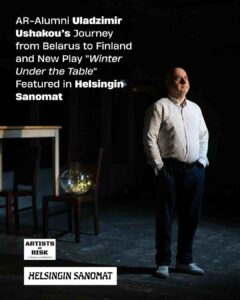
In the capital of Belarus, Ushakou was the founder and director of the key independent Modern Art Theater, known for tackling social and political themes. Following the fraudulent elections and the largest anti-government protests in the country’s history in 2020, “[t]he Belarusian KGB warned that if we presented [our theatre] to the public, they would arrest both the actors and the audience”. Ushakou was forced to flee Belarus in autumn 2020, and Ukraine was the ideal location. In Kyiv, he made a new start, founding the Belarusian Theater. However, less than two years later Russia launched its full-scale invasion of Ukraine. Forced to flee again, he eventually was welcomed by Artists at Risk (AR) at AR-Safe Haven Helsinki, where he lives today.
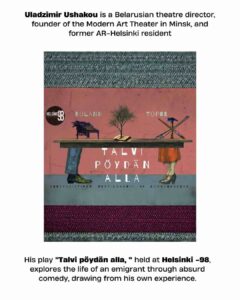
The play “Talvi pöydän alla” is an adaptation of Roland Topor’s “L’Hiver sous la table”, in which a refugee lives in a strange sub-let: a space under a table. This absurd comedy of an undocumented refugee in France appealed to Uladzimir Ushakou because, as he says, “[h]ope is essential in the current state of the world.” Its central premise is an immigrant who moves “from under the table to the table”, and becomes a part of the community.
“Many want to return home,” says Marita Muukkonen, co-founder of Artists at Risk (AR) with Ivor Stodolsky, but have no choice but to stay longer and make their place of refuge their new home.
Ushakou heard about Artists at Risk (AR) from his friend and fellow theatre (and film) maker Andrei Kureichik. Kureichik was the first Belarusian artist at AR-Safe Haven Helsinki. Less than a year after he arrived, he was snapped up by Yale University, where he entered a prestigious programme for future world leaders, and has since become a regular lecturer and stages plays around the USA. As the author of the article, Laura Kytölä.
Summarises: “It raises the question of whether we [in Finland] have understood the potential of immigrant artists.”
A big thank you to Helsingin Sanomat and Laura Kytölä for the support and recognition!
“Talvi pöydän alla” runs until 15 December at Helsinki -98 theatre (Vuosaarentie 7, 00980 Helsinki, Finland).
Tickets can be bought through the following link: https://fienta.com/fi/s/talvi-poydan-alla?fbclid=IwY2xjawNcPyVleHRuA2FlbQIxMABicmlkETBnWWpKN05nRENCazE1eXJ6AR6xWY1uGNHShe4U6JNHYzzSBGer-MKKVdCWkacM7xie-CjnOxAYxHJEgyB9dg_aem_dPVDd99qtEIzUGcUMs51nw
Read the original article in Helsingin Sanomat (in Finnish): https://www.hs.fi/taide/art-2000011596155.html
Full translation in English:
The Belarusian KGB threatened to arrest both the actors and the audience, and that is why Uladzimir Ushakou is now in Finland
Theatre | Theatre director Uladzimir Ushakou found it difficult to accept that he was an immigrant who could only wait. His new production is hopeful nonetheless.
Summary:
- Belarusian theatre director Uladzimir Ushakou first fled Belarus to Ukraine and, when the war began, to Finland.
- The Belarusian KGB threatened to arrest Ushakou and his actors in 2021, leading to the closure of their theatre in Minsk.
- Ushakou received asylum with the help of the Artists at Risk organization and is now directing the play Winter Under the Table, which deals with immigration and refuge.
On February 28, 2022, Belarusian theatre director, actor, and dissident Uladzimir Ushakou was sitting in a packed car on the way from Kyiv to Warsaw. With him were two beloved pet cats: Spartak the Abyssinian and Oskar the Turkish Angora.
Along the way, several explosions were heard. Russia’s invasion of Ukraine had begun. The planned premiere of the Belarusian Theatre that Ushakou had founded in Kyiv was overtaken by the war.
At one checkpoint, the car was stopped.
“A Ukrainian soldier noticed the Belarusian license plates and told us to go back to Aljaksandr Lukashenko,” Ushakou says through an interpreter.
When the driver – Ushakou’s friend – became nervous and said they opposed Lukashenko, the soldier snapped:
“I don’t care. Go back,”
and pointed his gun.
They had to turn back and drive to Warsaw through a detour in the forest.
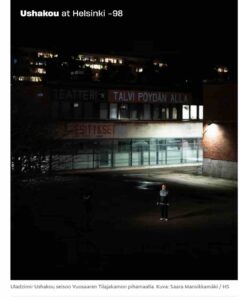
On March 5, 2022, Ushakou arrived at the Artists at Risk (AR) residency in Helsinki. He tells his story at the premises of Theatre Group Helsinki 98 in Vuosaari’s Tilajakamo.
The group is currently working on Winter Under the Table (1994), a tragicomedy by Roland Topor directed by Ushakou. It addresses immigration and refuge—precisely the situation Ushakou finds himself in now.
The start of Russia’s war was not the first time Ushakou was forced to abandon a premiere and flee.
In January 2021, Ushakou was rehearsing The Former Son (2014, by dissident and political activist Sasha Filipenko) at the Belarusian Modern Art Theatre he founded in Minsk in 2004. The play is a satirical depiction of a country under authoritarian rule.
Then Ushakou’s phone rang.
“The Belarusian KGB warned that if we performed it for an audience, they would arrest both the actors and the audience,” Ushakou says.
Threats and warnings had been coming for a long time after the protests against Lukashenko’s authoritarian regime began in August 2020. Obtaining permits for performances had become difficult.
“They hindered our performances in every possible way. For example, the fire department might suddenly show up and claim the venue was unfit for performance.”
Ushakou’s and his actors’ active anti-government actions—participating in demonstrations and speaking to the media—had been noticed.
Half an hour before the premiere on January 5, 2021, the fire department arrived at the theatre in Minsk and banned the performance. The next day, the authorities closed the theatre entirely.
Ukraine had begun issuing visas to Belarusian opposition figures in 2020, and Ushakou left for Kyiv in early 2021. He still thought he might return to Belarus.
“I was hopeful; I thought the situation would change. But when Vitali Shishov, the head of an organization helping Belarusians escape abroad, was murdered in August 2021, I understood I could not return.”
According to human rights organizations, about 1,400 people have been imprisoned in Belarus for protesting against Lukashenko’s rule.
“Hope is essential in the current global situation.”
Right now, Ushakou’s situation resembles that of the protagonist in Winter Under the Table, who lives in France as an undocumented refugee.
Ushakou has applied for asylum in Finland, and his status is currently being processed by the Finnish Immigration Service (Migri. In that sense, he is also “under the table,” waiting in a cramped mental space.
“Accepting that I am an immigrant was difficult,” he says.
Ushakou is studying Finnish and attends theatre performances frequently. At first, he was surprised by the detailed nature and slowness of Finnish theatre.
“They have a bit of the feel of documentary film,” he analyzes.
What is strikingly absent from Finnish theatre, he says, are performances about immigration and Ukraine.
“In political discussions you often hear that immigrants are to blame for all difficulties, but in theatre the topic is not addressed,” Ushakou remarks.
In March 2023, Ushakou directed a Russian-language radio play version of Bertolt Brecht’s Refugee Conversations for Yle. What appeals to him in Winter Under the Table is its brightness.
“Hope is essential in the current global situation.”
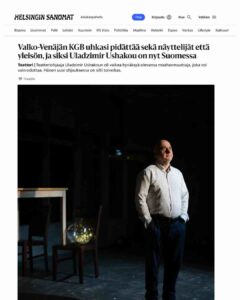
“Belarusian theatre has a faster pace and more action than Finnish theatre,” analyzes Uladzimir Ushakou. (Photo: Saara Mansikkamäki / HS)
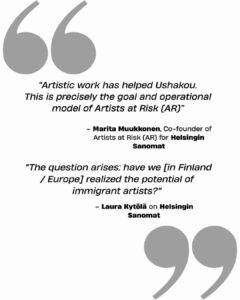
Artistic work has helped Ushakou.
This is precisely the goal and operational model of Artists at Risk (AR), says Marita Muukkonen, who co-founded the organization in 2013 with Ivor Stodolsky. The organization has more than 300 residency partners around the world; in Finland, residencies exist in Porvoo, Tampere, and Fiskars, among others.
Artists living in residencies are offered support and work opportunities. In Finland, this is provided by institutions such as the Finnish National Theatre, the Circus and Dance Information Centres, Yleisradio, and the Espoo & Theatre.
The number of applications has only grown.
“When the Taliban came to power in Afghanistan, we received thousands of applications. The beginning of the war in Ukraine brought another large wave,” Muukkonen says.
The organization has placed more than 1,100 art professionals around the world, 685 of whom are Ukrainian. Regional risk analysts verify whether threats and persecution are real. One of the criteria is the applicant’s professional status as an artist.
Residencies last from three months to a year and a half. Muukkonen says that typically, artists come to a residency when they need a breather.
“Many want to return and work locally again.”
Ushakou heard about the organization from his dramaturge friend, Andrei Kureichik, who was the first Belarusian artist placed in Helsinki by AR. Kureichik has since moved to the United States and teaches at Yale.
The question arises: have we realized the potential of immigrant artists?
Winter Under the Table premieres on Nov 19, and Doctor J. Faust’s Personal Score Written After His Death, directed by Pavel Semtšenko, premieres on Dec 10 at the Helsinki 98 stage in Vuosaari’s Tilajakamo.
