


Link to original article:
https://culturab.cat/entrevistes/iranians-exili-artistic-monstres-no-negocia-europa-ho-hauria-veure/
Automated machine translation:
Iranians from artistic exile: “You don’t negotiate with monsters; Europe should see that”
Joana Justícia | 12 March 2026 | Barcelona (Eixample) | Cultura B
Writer Mahsa Mohebali and her husband Hossein Zoghi
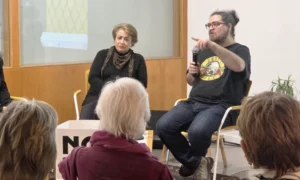
Writer Mahsa Mohebali and her husband Hossein Zoghi at an event in Barcelona. Photo provided.
None of Mahsa Mohebali’s books can be published in Iran, her country of birth. The renowned writer has been subjected to constant pressure and surveillance by Iranian security forces because of the critical nature of her work. She is now in exile in Catalonia, specifically in Ribes de Freser, together with her husband, Hossein Zoghi. He is a journalist, theatre director and actor whose career has been marked by the banning of his texts criticizing the regime. Zoghi was barred from official theatre activities in Iran.
For the past four months, both have been part of the international residency program Artists at Risk, which is based in Barcelona through the organization No Callarem (the next issue of Cultura B magazine will feature an extensive report on this entity).
Although they live in Ribes de Freser, much of their cultural life takes place in Barcelona. We speak with the couple before they participate this Thursday afternoon in a discussion at the Centre Cívic Ateneu Fort Pienc, where the documentary The Day of the Apple about the suburbs of Tehran will be screened as part of the Cinestèsies series.
They are also creating a theatre piece, El Pou / El Cos (The Well / The Body), about women’s resistance in Iran, written by her and directed by him. It has not yet been publicly announced, but it will be shown in May at Sala Beckett. “Artistic resistance in Iran is very important,” they say during the interview.
To begin with, could you introduce yourselves as journalist and writer?
Mahsa Mohebali:
I’ve been writing since I was 16. I studied music at the University of Tehran, and later returned to literature. I’ve published five books in Iran and written several film scripts. In recent years I’ve had many problems publishing my work, so I did it in Afghanistan instead. During the last year I lived in Iraqi Kurdistan, from where I applied for the Artists at Risk residency. They gave us a six-month stay in Barcelona.
Hossein Zoghi:
I studied theatre at the University of Tehran and worked in many public theatres in Tehran as an actor and director. But in 2009, after the post-election protests, I moved to underground theatre and mostly worked in friends’ apartments. I needed money to live, so I began working as a journalist.
“Now the people of Iran believe they can fight the government.”
What projects are you working on with the Artists at Risk program?
H.Z.:
It’s fantastic to be here because when we were in Iran we weren’t allowed to work—especially Mahsa. She was banned from publishing books, writing, speaking, and teaching. Now we can do anything freely. Mahsa has written a theatre script about the resistance of Iranian women and women around the world, and I will direct it at Sala Beckett. No Callarem will produce it. I’m also writing for some newspapers.
M.M.:
I’m finishing a new novel and starting to write a book based on my diaries. We feel very comfortable in Ribes de Freser, and we’ve made many friends.
How are you receiving news from your country these days?
H.Z.:
March 8 was a terrible day because Israel and the United States attacked Iran’s oil facilities. The sky over the country looks apocalyptic. It’s dark and oil is raining down in Tehran. Everyone is scared, but life goes on. Some friends say the current war is slightly better than previous ones because people are more prepared—but it’s still war.
M.M.:
I think Iran is in a new situation. Mojtaba Khamenei, son of Ali Khamenei, is now the new Supreme Leader of Iran. We hope he isn’t as crazy as his father.
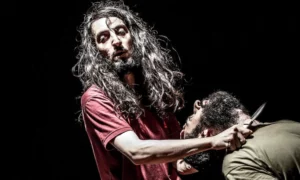
Because of his political approach, Zoghi was banned from official theatre activities in Iran. Photo: Leila Ebrahimi.
Do you still have family and friends in Iran?
H.Z.:
All my family and friends are there. They’ve cut the internet—something the government does whenever it has problems. I managed to contact one or two friends and spoke once with my mother because she called me via internet; international calls are very expensive. They’re frightened by the sound of missiles. My mother has moved to a village in the north of the country because my brother has had a mental illness for years and needs a quiet place. Still, they’re okay.
M.M.:
I’ve been worried about a writer and poet friend of mine, Yousef Ansari, who is in prison after being arrested in January. Before the internet shutdown I was in contact with friends trying to get him out, but now I don’t know what has happened. I’m very worried. All prisoners in Iran are currently in danger because they have no food or proper care. It’s horrible.
Why did you leave Iran?
H.Z.:
We decided after the Twelve-Day War. We were terrified to leave the house. It was a war in the city—planes, drones, missiles heading toward Tehran. You never knew where they would fall. We only went out to buy essentials like food and water. It’s hard to realize that both of us have spent our lives in war. We’ve lived through so many protests in the past 20 years… It’s a terrifying life.
M.M.:
When we were nine years old the Iran–Iraq War began. So we had already experienced war, but the younger generations hadn’t. During the Twelve-Day War many were paranoid and in shock.
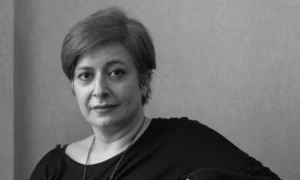
None of the books by Mahsa Mohebali can be published in Iran, her country of birth. Photo provided.
Today you’re taking part in a discussion about a documentary made after the death of Mahsa Jina Amini in 2022, which triggered the “Women, Life, Freedom” movement. How has Iranian society changed since then?
M.M.:
After the 1979 revolution, repression increased, especially against women. Women can’t ride bicycles, go to football stadiums, dance or sing, and they must follow discriminatory Islamic laws. Since then women have resisted—sometimes not through big demonstrations but through daily acts. For example, they would gradually move their headscarf further back until it fell off.
But when Mahsa Amini died, women truly became angry. Even older women removed their scarves and went out to say that if this could kill someone, they would never wear it again. If we see so many people on the streets now, it’s because Amini’s case was a turning point for women’s movements in Iran and around the world.
Has this movement led by women and young people changed the relationship between society and the regime?
H.Z.:
The regime hasn’t changed. The difference is that a young generation has assumed its rights as normal customs. It’s daily resistance.
M.M.:
The government arrested young women for not wearing the hijab, canceled their bank accounts, SIM cards and confiscated their cars. In response, women kept paying the fines every day. Eventually the government realized it couldn’t fight them daily and backed down.
H.Z.:
One benefit of the women’s freedom movement is the courage it has given people. Now Iranians believe they can fight the government.
Europe often analyzes Iran mainly through geopolitics. Are citizens’ perspectives sometimes missing?
H.Z.:
Yes, because Europe’s view is shaped by the Israel–Gaza conflict. Some think the Iranian government isn’t bad because it supports Gaza and opposes Israel. But we know it’s a monster. Iran has been in conflict with the United States and Israel for 47 years. Europe should look at it from a human-rights perspective. Our government is a monster, and you can’t negotiate with monsters.
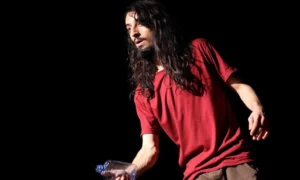
In Tehran, Zoghi directs productions in the underground theatre scene. Photo: Leila Ebrahimi.
In Europe, the Israel-Palestine conflict mobilizes huge public attention, while Iranian struggles receive less. Why?
H.Z.:
Right now Gaza and Israel are all that matter for many Europeans. But why didn’t Europe support Iran two months ago when 30,000 people died in the streets? It’s strange.
Some Iranians abroad wave Israeli flags in protests; I don’t support that either, because Israel’s government is also a monster. Europeans should look clearly at the situation and support the Iranian people, who have suffered under a regime that has killed many. If Europeans examined the theocracy and the fascism of Iran’s Islamic rules, they would see that the country lives under the same kind of fascism that Spain and Italy once experienced.
M.M.:
It’s important to separate the people from the government. In that sense we’re in the same situation as Gaza.
How do you see foreign intervention and international pressure?
H.Z.:
Before Israel and the United States attacked Iran, many people—including me—supported foreign intervention because we believed we couldn’t overthrow the Islamic regime alone. In January and February the government proved it could easily kill people, yet the world said nothing.
Now that bombs and missiles are falling, people are paying attention to Iran. This is the moment when governments—especially European ones, like Pedro Sánchez has done—should oppose the war and force the Islamic Republic to stop, listen to the Iranian people and step down. I’m not a politician; I don’t know how exactly it should happen. But our people are trapped between a huge war and a brutal regime, and the world should stand with them.
Finally, what does Europe misunderstand about Iranian society?
M.M.:
There’s something very important: in Iran there is the life inside the home and the life outside. At home we drink alcohol and live freely like people in Europe or the United States. But outside everyone appears religious—praying, following the rules.
When Europeans see those images they ask, “Why are you like this?” It’s because public life is different. Even gestures are different—we can’t kiss or hug in public. Outside we’re someone else, like wearing a mask. And this difference is often lost when people talk about Iran.
H.Z.:
Yes—and it’s hard to understand because of the regime’s censorship and propaganda.
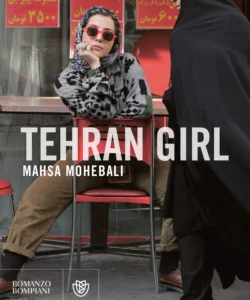
“Tehran Girl,” a novel written by Mahsa Mohebali, is an international bestseller that tells a love story set in 1950s Iran. Photo provided.
